

General Cancer Prevention
Cancer-Fighting Food Recommendations from the World's Leading Cancer Organizations
Modify your diet to decrease your cancer risk
Nearly half of all people will face a cancer diagnosis in their lifetime, making it one of the world's leading causes of death. The encouraging news? Medical experts estimate that 30-50% of cancers can be prevented through lifestyle choices.
Your diet is one of your most powerful prevention tools, yet finding reliable guidance can feel overwhelming and confusing. Major cancer organizations scatter their recommendations across inconsistent formats, leaving you to piece together fragments of advice from dozens of sources.
We've solved this problem by systematically reviewing and consolidating nutrition recommendations from major cancer institutes and societies worldwide.
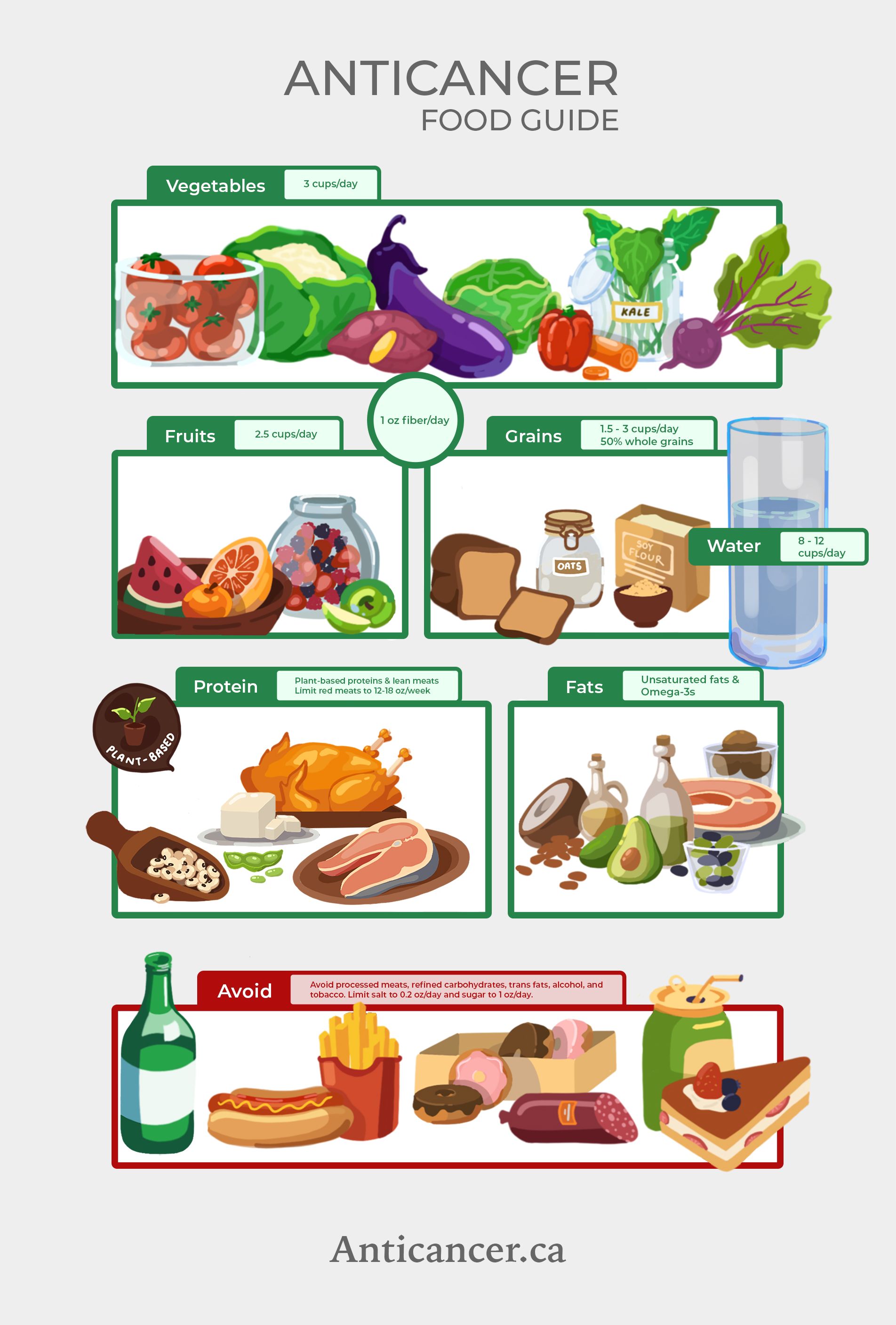
🖨️ Click here to download or print the Anticancer Food Guide
Basic Cancer Prevention Guidelines
These foundational recommendations from leading cancer organizations provide an accessible starting point for reducing your cancer risk through daily food choices.
Daily Food Choices
- Eat a variety of fruits and vegetables
- Choose whole grains over refined options
- Increase fibre intake
- Stay hydrated by drinking water instead of sugary drinks
Weekly Considerations
- Limit red meat to 12-18 ounces (340-510g; ~1.5-2.25 cups)
- Choose plant-based proteins when possible
- Reduce processed foods, especially those high in sugar, salt, and unhealthy fats
Foods to Limit
- Trans fats found in many processed and fried foods
- Foods high in added sugar
- Highly processed carbohydrates
- Alcoholic beverages should be limited to two or fewer per week
Optimal Prevention Guidelines
For maximum reduction in cancer risk, the following comprehensive changes are recommended by major cancer organizations.
Daily Food Choices
- Fruits: 2.5 cups in a variety of colors
- Vegetables: 3 cups in a variety of colors
- Consumption of beans should add up to 1.5-3 cups per week
- Fibre: 30 grams
- Grains: 1.5-3 cups total grains (at least half of which should be whole grains)
- Water: 8-12 cups daily (around 2-3L)
- Proteins: Choose plant-based sources when possible. If eating animal protein, fish and poultry are preferred over red meat
- Soy: Up to 50 milligrams of soy isoflavones can be consumed
- Whole Foods: focus on fulfilling nutritional requirements with whole foods, instead of using supplements as substitutes (unless specifically recommended by your physician)
Foods to Limit
- Sugar: Keep sugars under 100 calories per 2000 calories consumed
- Salt: No more than 5-6 grams daily
- Added fats: Avoid trans fats completely and limit saturated fats
- Red meat: Limit to 12-18 ounces per week, with no more than 3 ounces per meal
Foods to Avoid
- Heavily processed foods such as frozen meals, potato chips and candies
- Processed meats such as bacon, sausage, hot dogs, and deli meats
- Refined carbohydrates such as white breads and pastas, pastries, and many cereals
- Trans fats, commonly found in fried foods and pastries
- Alcohol and tobacco
Cooking Methods
The way you prepare foods, especially muscle meat proteins (including beef, pork, fish or poultry), can significantly impact their cancer risk profile. High-temperature cooking methods can create potentially harmful compounds, including heterocyclic amines (HCAs) and polycyclic aromatic hydrocarbons (PAHs).
Lower-temperature, moisture-based cooking methods generally produce fewer of these compounds. Another way to potentially reduce the formation of harmful compounds when cooking meats is by using acidic marinades such as lemon juice and vinegar.
Cooking Methods to Avoid
- High temperature and/or prolonged heat exposure
- Pan frying
- High-temperature grilling (especially over an open flame)
- Smoking
Recommended Cooking Methods
- Low temperature and/or brief heat exposure
- Baking
- Boiling
- Poaching
- Steaming
- Stewing
How Foods Fight Cancer
📄 Detailed General Cancer Prevention Notes by Anticancer.ca
Understanding how foods affect cancer risk can help motivate lasting dietary changes. Here's what makes certain foods powerful cancer fighters:
The Benefits of a Plant-Rich Diet:
Plants produce thousands of natural compounds called phytochemicals to protect themselves from disease. These same compounds act as powerful antioxidants that protect your cells by:
- Aiding in DNA and cell damage repair, preventing mutations that can lead to cancer
- Reducing inflammation throughout the body
- Supporting your immune system and directly inhibiting cancer cell growth
General Colour Guide to Phytochemicals:
- Red foods (tomatoes, watermelon): Lycopene
- Orange/Yellow foods (carrots, sweet potatoes): Beta-carotene
- Green foods (broccoli, kale): Sulforaphane and isothiocyanates
- Blue/Purple foods (berries, eggplant): Anthocyanins
- White foods (garlic, onions): Allicin
Fibre’s Protective Effects
Fibre is a type of carbohydrate found in plant-based foods that the body cannot digest or absorb, yet it is essential for a healthy digestive system. In addition to supporting regular digestion, fibre also helps reduce cancer risk by:
- Flushing out carcinogens before they can cause damage
- Feeding good gut bacteria, which produce compounds that fight inflammation
- Regulating hormones that could otherwise promote cancer
- Helping manage weight, lowering the risk of obesity-related cancers
Whole Foods vs. Processed Foods
Whole foods retain their natural balance of nutrients, fibre, and beneficial compounds.
Processing food often:
- Removes beneficial fibre and nutrients
- Introduces preservatives, artificial colors, and flavors that may increase cancer risk
- Increases calorie density while decreasing nutritional value
This is why cancer prevention guidelines consistently emphasize whole, minimally processed foods over highly processed alternatives.
Tips & Tricks
Better Ways to Add Flavor:
- Do: Use plain yogurt, healthy oils, and herbs to add flavor to fruits and vegetables
- Why: Flavor is often enhanced by adding saturated fats or sugar, which can counteract health benefits
Choose Smoothies Over Juice:
- Do: Blend whole fruits and vegetables to maintain fibre content and avoid insulin spikes from concentrated sugars
- Why: Juices are often high in sugar, lack fibre, and won't keep you satisfied between meals
The Cancer Prevention Plate:
- Do: Structure meals with 2/3 plant-based foods (such as whole grains, fruits, vegetables, beans) and 1/3 can be animal-based protein (such as poultry, seafood, dairy, and sometimes red meat)
- Why: This approach focuses on portion and proportion rather than centering meals around meat. It creates filling, well-balanced meals packed with nutritional value that leave you pleasantly satisfied while helping you maintain your weight and overall health
Nutritional Powerhouses to Include
Whole Grains:
- Do: Choose brown rice, wild rice, whole wheat, oats, barley, quinoa, buckwheat, and rye
- Why: These provide fibre, phytonutrients, vitamins, minerals, and complex carbohydrates that refined grains lack
Cancer-Fighting Seeds:
- Do: Include ground flaxseed, hemp seeds, chia seeds, pumpkin seeds, and sunflower seeds in your diet
- Why: Seeds are a great source of macronutrients, fibre, phytonutrients, antioxidants, vitamins, and minerals. Some of these compounds help reduce inflammation, oxidative stress, and other processes that are linked to an increased cancer risk.
- Ground flaxseed: source of healthy omega-3 fatty acids, fibre, and lignans that may help fight cancer
- Caution: Consult your doctor about flaxseed if taking other medications or if you have a history of bowel obstruction
- Hemp seeds: source of plant-based protein and healthy omega-3 and omega-6 fatty acids, antioxidants, vitamins and minerals
- Chia seeds: source of healthy omega-3 fatty acids, and antioxidants
- Pumpkin seeds: source of healthy omega-6 and omega-9 fatty acids, antioxidants, vitamins and minerals
- Sunflower seeds: source of healthy omega-6 and omega-9 fatty acids, antioxidanrs, vitamins and minerals
- Ground flaxseed: source of healthy omega-3 fatty acids, fibre, and lignans that may help fight cancer
Addressing Common Controversies
Dairy Products
The Issue: Research shows mixed results; some studies suggest certain cancers may increase with dairy consumption, while others indicate some cancers may increase without dairy.
Bottom Line: There's no universal recommendation. Focus on overall dietary patterns rather than eliminating or emphasizing dairy specifically.
Meat vs. Plant-Based Diets
The Issue: Organizations offer conflicting advice on meat consumption:
- Mayo Clinic suggests eliminating meat could prevent up to 1/3 of cancers
- World Cancer Research Fund International recommends limiting rather than eliminating meat, noting it provides protein, iron, zinc, and vitamin B12. However, they acknowledge that these nutrients can be sourced from plant-based diets.
Bottom Line: While these nutrients can be obtained from plant sources, complete elimination isn't necessary. All organizations agree on limiting red and processed meats and avoiding charred preparation methods.
Organic Foods
The Issue: Many assume organic foods are more nutritious or safer for cancer prevention.
Bottom Line: There is no evidence to suggest that organic foods offer more nutritional value than non-organic foods. The nutritional benefit gained from eating fruits and vegetables outweighs the risk of eating non-organic produce. Nonetheless, everyone is encouraged to wash their fruits and vegetables regardless of whether they are organic or not.
Summary
| Recommendation | Amount | Explanation and Tips |
|---|---|---|
| Vegetables | 3 cups/day | Nutrient-rich. Prefer organic, but wash thoroughly regardless. |
| Fruits | 2.5 cups/day | Nutrient-rich. If juiced, blend whole fruits. Organic not necessary, but wash thoroughly. |
| Grains | 1.5 to 3 cups/day (half wholegrains) | Whole grains offer fibre, vitamins, and minerals. |
| Fibre | 30 grams/day | Reduces hunger and slows digestion. Increase intake gradually. |
| ProteinFats | Varies (lean meats and plant-based proteins preferred) | Necessary for cell growth and tissue repair. Limit red and processed meats, avoid charring. Plant proteins can replace meat.Avoid trans fats due to cancer risk. |
| WaterDairy | 8 to 12 cups/day | Supports overall health.Recommendations vary. Adjust based on individual needs. |
| Foods to limit | Red meat: 12-18 ounces/week, Sugar: 100 calories out of 2000 calories, Salt: 5 to 6 grams/day | Limit red meat, sugar, and salt for a healthier diet. |
| Foods to avoid | Processed meat, refined carbs, trans fats, alcohol, tobacco | All linked to increased cancer risk. |
Up to half of cancer cases are preventable with the proper lifestyle choices, with a large and often overlooked factor being diet and body mass index. An excellent baseline diet covering the recommendations from all the major cancer organizations would be to follow the cumulative instructions in our minimum or aggressive recommendations. Generally, the top cancer organizations recommend increasing fruits, vegetables, fibres, whole grains, seeds, and water intake. Red meats, sugar, and salt should be limited, and one should avoid heavily processed foods (including processed meats, refined carbohydrates, trans fats), alcohol, and tobacco. Home-cooked meals are also favored. The recommendations listed are consistent with most organizations' recommendations for overall health and anti-aging benefits as well as personalized prevention plans.
To discuss the inclusion of your institution's recommendation, or to modify the recommendations sourced from your institution, email info@anticancer.ca
Subscribe for updated information, including recommendations for specific cancers, features discussing the reasoning and evidence behind certain recommendations, and reviews of primary research papers and randomized controlled clinical trials that investigate specific nutrients and supplements.
Frequently Asked Questions
References
- American Academy of Family Physicians. Published 2018, June 1. Accessed 2025, September 25. Nutrition: How to make Healthier Food Choices. American Family Physician. https://www.aafp.org/pubs/afp/issues/2018/0601/p721-s1.html
- Apetroaei, V. T., Pricop, E. M., Istrati, D. I., & Vizireanu, C. Published 2024, May 1. Accessed 2025, September 25. Hemp Seeds (Cannabis sativa L.) as a Valuable Source of Natural Ingredients for Functional Foods - A Review. Molecules. https://pmc.ncbi.nlm.nih.gov/articles/PMC11085560/
- Batool, M., Ranjha, M. M. A. N., Roobab, U., Manzoor, M. F., Farooq, U., Nadeem, H. R., Nadeem, M., Kanwal, R., AbdElgawad, H., Al Jaouni, S. K., Selim, S., & Ibrahim, S. A. Published 2022, May 24. Accessed 2025, September 25. Nutritional Value, Phytochemical Potential, and Therapeutic Benefits of Pumpkin (Cucurbita sp.). Plants. https://pmc.ncbi.nlm.nih.gov/articles/PMC9182978/
- Canadian Cancer Society / Société canadienne du cancer. Eat more veggies fruit and fibre. Canadian Cancer Society. Accessed 2025, September 25. https://cancer.ca/en/cancer-information/reduce-your-risk/eat-well/eat-more-veggies-fruit-and-fibre
- Canadian Cancer Society. Accessed 2025, September 25. Cancer statistics at a glance. Cancer statistics. https://cancer.ca/en/research/cancer-statistics/cancer-statistics-at-a-glance
- Cancer risk statistics. Cancer Research UK. Published 2025, March 19. Accessed 2025, September 25. https://www.cancerresearchuk.org/health-professional/cancer-statistics/risk
- Chemicals in meat cooked at high temperatures and cancer risk. National Cancer Institute. Accessed 2025, September 25. https://www.cancer.gov/about-cancer/causes-prevention/risk/diet/cooked-meats-fact-sheet
- Colon cancer prevention. Johns Hopkins Medicine. Published 2024, June 19. Accessed 2025, September 25. https://www.hopkinsmedicine.org/health/conditions-and-diseases/colon-cancer/colon-cancer-prevention
- Cordova, R., Viallon, V., Fontvieille, E., Peruchet-Noray, L., Jansana, A., Wagner, K.-H., Kyrø, C., Redondo-Sánchez, D., Jakszyn, P., van der Schouw, Y. T., Verschuren, W. M. M., Boer, J. M. A., Tumino, R., Ricceri, F., Panico, S., Sieri, S., Masala, G., Schulze, M. B., Bajracharya, R., … Tjønneland, A. Published 2023, December. Accessed 2025, September 25. Consumption of ultra-processed foods and risk of multimorbidity of cancer and cardiometabolic diseases: A multinational cohort study - the lancet regional health - europe. The Lancet Regional Health Europe. https://www.thelancet.com/journals/lanepe/article/PIIS2666-7762(23)00190-4/fulltext
- Diet. European Institute of Oncology. Accessed 2025, September 25. https://www.ieo.it/en/Patient-Care/Lifestyle/Diet/
- Diet. MD Anderson Cancer Center. Accessed 2025, September 25. https://www.mdanderson.org/prevention-screening/manage-your-risk/diet.html
- Eat a diet rich in whole grains, vegetables, fruits, and beans. American Institute for Cancer Research. Accessed 2025, September 25. https://www.aicr.org/cancer-prevention/recommendations/eat-a-diet-rich-in-whole-grains-vegetables-fruits-and-beans/
- Hossain, M. S., Wazed, M. A., Asha, S., Amin, M. R., & Shimul, I. M. Published 2025, March 19. Accessed 2025, September 25. Dietary Phytochemicals in Health and Disease: Mechanisms, Clinical Evidence, and Applications - A Comprehensive Review. Food Science & Nutrition. https://pmc.ncbi.nlm.nih.gov/articles/PMC11922683/
- Hu, J., Wang, J., Li, Y., Xue, K., & Kan, J. Published 2023, May 30. Accessed 2025, September 25. Use of Dietary Fibers in Reducing the Risk of Several Cancer Types: An Umbrella Review. Nutrients. https://pmc.ncbi.nlm.nih.gov/articles/PMC10255454/
- Kliemann, N., Al Nahas, A., Vamos, E. P., Touvier, M., Kesse-Guyot, E., Gunter, M. J., Millett, C., & Huybrechts, I. Published 2022, March 2. Accessed 2025, September 25. Ultra-processed foods and cancer risk: from global food systems to individual exposures and mechanisms. British Journal of Cancer. https://pmc.ncbi.nlm.nih.gov/articles/PMC9276654/
- Makki, K., Deehan, E. C., Walter, J., & Bäckhed, F. Published 2018, June 13. Accessed 2025, September 25. The Impact of Dietary Fiber on Gut Microbiota in Host Health and Disease. Cell Host & Microbe. https://www.sciencedirect.com/science/article/pii/S193131281830266X
- Mayo Foundation for Medical Education and Research. Published 2024, November 23. Accessed 2025, September 25. 7 healthy habits that can lower your risk of cancer. Mayo Clinic. https://www.mayoclinic.org/healthy-lifestyle/adult-health/in-depth/cancer-prevention/art-20044816
- Mayo Foundation for Medical Education and Research. Published 2025, March 26. Accessed 2025, September 25. Flaxseed and flaxseed oil. Mayo Clinic. https://www.mayoclinic.org/drugs-supplements-flaxseed-and-flaxseed-oil/art-20366457
- Msk Catch Nutrition Plan. Memorial Sloan Kettering Cancer Center. Published 2021, August 5. Accessed 2025, September 25. https://www.mskcc.org/cancer-care/patient-education/msk-catch-nutrition-plan
- New American Plate. American Institute for Cancer Research. Accessed 2025, September 25. https://www.aicr.org/cancer-prevention/healthy-eating/new-american-plate/
- Petraru, A., Ursachi, F., & Amariei, S. Published 2021, November 17. Accessed 2025, September 25. Nutritional Characteristics Assessment of Sunflower Seeds, Oil and Cake. Perspective of Using Sunflower Oilcakes as a Functional Ingredient. Plants. https://pmc.ncbi.nlm.nih.gov/articles/PMC8619027/
- Uribarri, J., Woodruff, S., Goodman, S., Cai, W., Chen, X., Pyzik, R., Yong, A., Striker, G. E., & Vlassara, H. Published 2010, June. Accessed 2025, September 25. Advanced Glycation End Products in Foods and a Practical Guide to Their Reduction in the Diet. Journal of the American Dietetic Association. https://pmc.ncbi.nlm.nih.gov/articles/PMC3704564/
- What is a balanced diet?. Dana-Farber Cancer Institute. Published 2019, February 21. Accessed 2025, September 25. https://blog.dana-farber.org/insight/2019/02/what-is-a-balanced-diet/
- World Health Organization. Accessed 2025, September 25. Cancer. https://www.who.int/news-room/fact-sheets/detail/cancer
- Zhou, Y., Li, X., Luo, W., Zhu, J., Zhao, J., Wang, M., Sang, L., Chang, B., & Wang, B. Published 2022, June 13. Accessed 2025, September 25. Allicin in digestive system cancer: From biological effects to clinical treatment. Frontiers in Pharmacology. https://pmc.ncbi.nlm.nih.gov/articles/PMC9234177/
About This Article
| First Published | April 10, 2023 |
| Last Updated | September 21, 2025 |
| Author | Ashiana Sunderji |
| Fact Checkers and Co-Authors | Maia Edney, Aria Panchal and Courtney Leung |
| Illustrator | Supriya Saha |
| Reviewer and Supervisor | Kenneth W. Yip |
Disclaimer
The content on Anticancer.ca is intended for educational and informational purposes only and does not serve as a substitute for professional medical advice or services. Consult a licensed physician for personalized medical advice or questions about your health. Do not disregard professional advice or delay seeking help based on information found on our website. In case of a medical emergency, call 911 or visit the nearest emergency room immediately.
Anticancer.ca strives to provide accurate and reliable information, but cannot guarantee its error-free or comprehensive nature. We are not responsible for the quality or endorsement of information, services, products, treatments, or therapies provided by third parties mentioned on our website. Always consult a qualified healthcare professional before making medical decisions.